Battery-in-Grid Cadence Exposure Review / v0.1

Your revenue is not cadence-neutral.

Public BMRS accepted actions reveal how assets are called: persistently, briefly, direction-switching, or episodically. This board identifies external balancing cadence patterns that should be compared with internal BMS, PCS, thermal, and degradation logs.

External call rhythm first. Asset-health claims later. We do not infer fatigue from public data. We show which units carry visible cadence exposure and where internal telemetry review should begin.

Is one of yours quietly becoming a concentrated bearer?

Public balancing read across all visible BM Units, positioned against same-class peers. Locate one asset, decide whether to act, and see what to check next — this is the same evidence the board below lets you explore unit by unit.

Public Elexon BMRS + NESO read
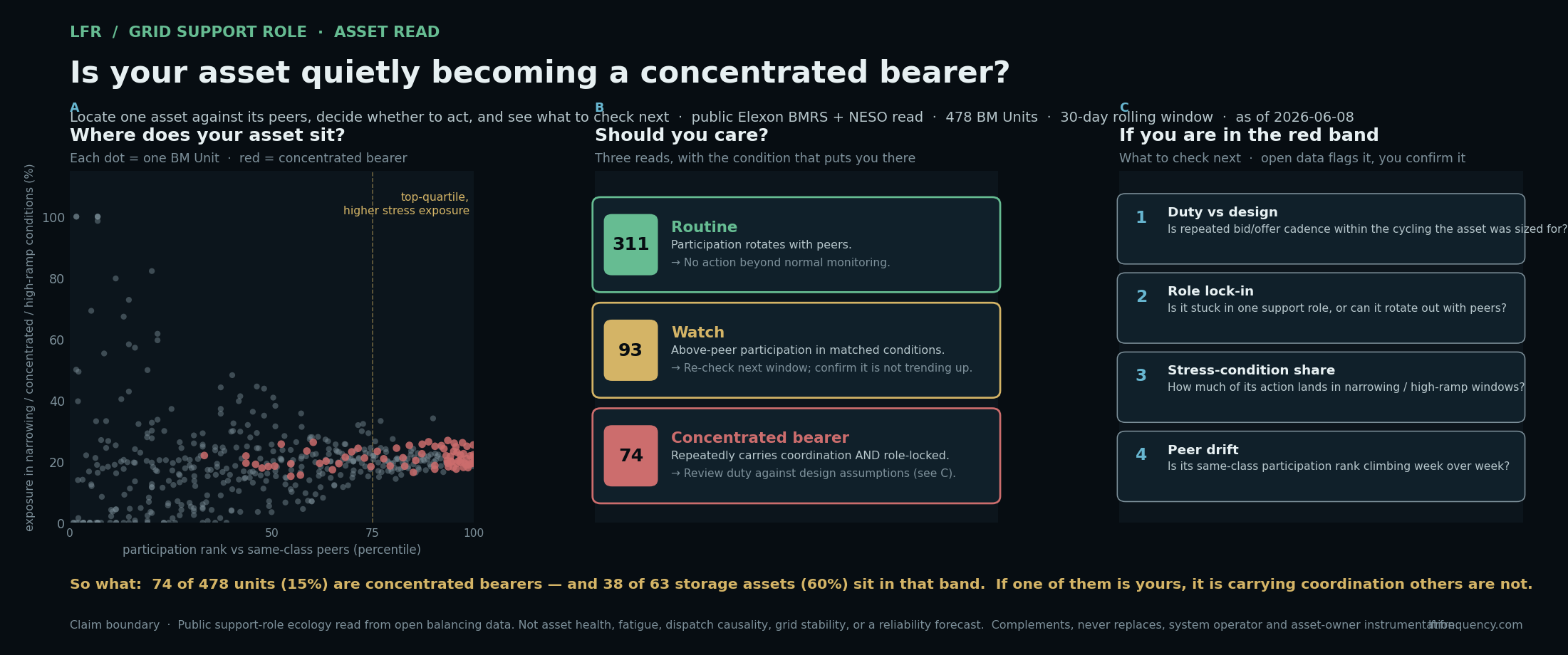
Asset-level support-role read: peer positioning, decision bands, and what to check next, derived from public GB balancing data.
External call rhythm and concentration first. Asset-health claims later. We do not infer fatigue, dispatch causality, grid stability, or reliability from public data — this read complements, never replaces, system-operator and asset-owner instrumentation.

Cadence Exposure Field

X = persistence. Y = short-duration cadence. Glow = directional switching.

Visible units
--
Persistent cadence
--
Switching candidates
--
Short-duration candidates
--
The question is not only how much revenue an asset earns. It is what rhythm the grid asks the asset to live in.
Observation only. Public Elexon BMRS accepted bid/offer data. Not asset health, fatigue, delivery quality, dispatch causality, market advice, grid stability assessment, or control.