Source and method
Dataset and attribution
Qu, Jingbo (2026), Dataset for: A Multi-Agent AI Framework for Explainable Battery System Maintenance, version v1, Zenodo, DOI 10.5281/zenodo.20094787. The published dataset metadata identifies CC BY 4.0 as its licence. The source metadata was checked on 18 September 2026. The dataset author does not endorse this exhibit or its interpretations.
LFR selected records, formed the explicitly partial current integrals and asynchronous cache examples, and re-presented them in figures and interactive displays. These transformations are not the original BMS implementation. The dataset author's paper conclusions are not used as evidence for the observations here.
Scope of this edition
The four chapters and full methods account are a descriptive demonstration, not a peer-reviewed paper or performance benchmark. All cases were selected after exploration. No representativeness, independent validation, prevalence estimate or complete physical biography is claimed. A local draft is retained separately; this web edition packages only the evidence listed below.
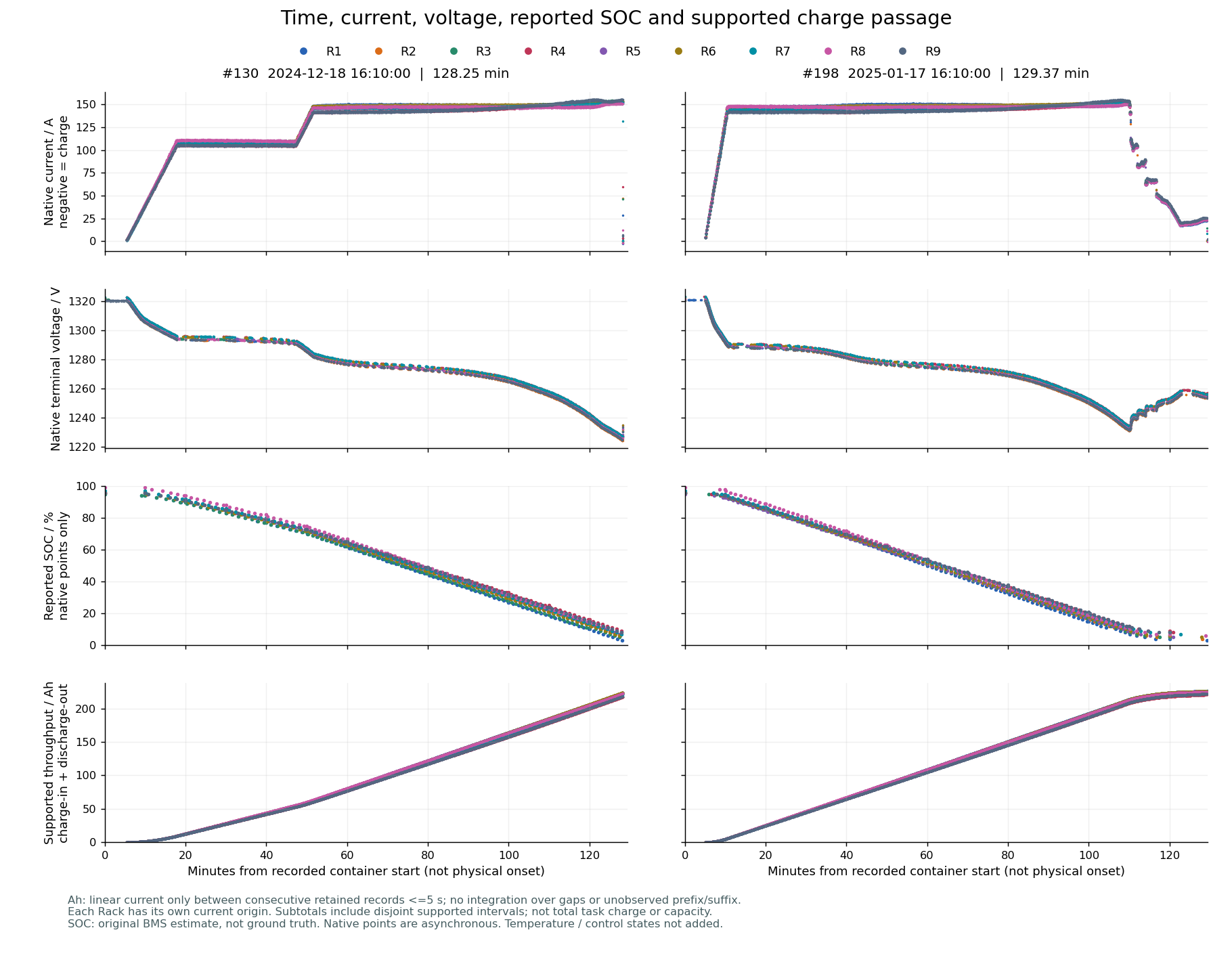
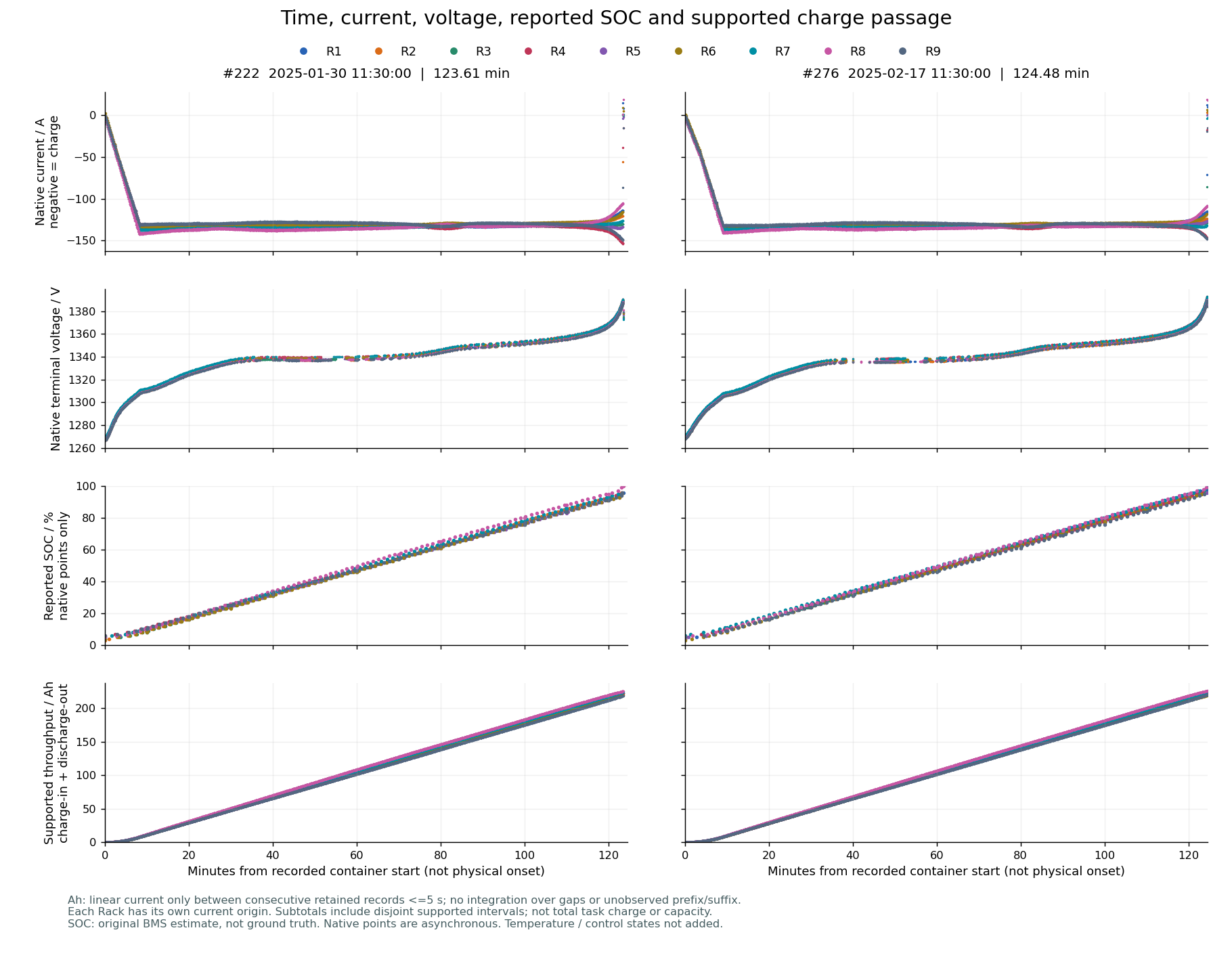
- Full I/V and separately timed SOC replay: #130, #198, #222 and #276, nine racks each.
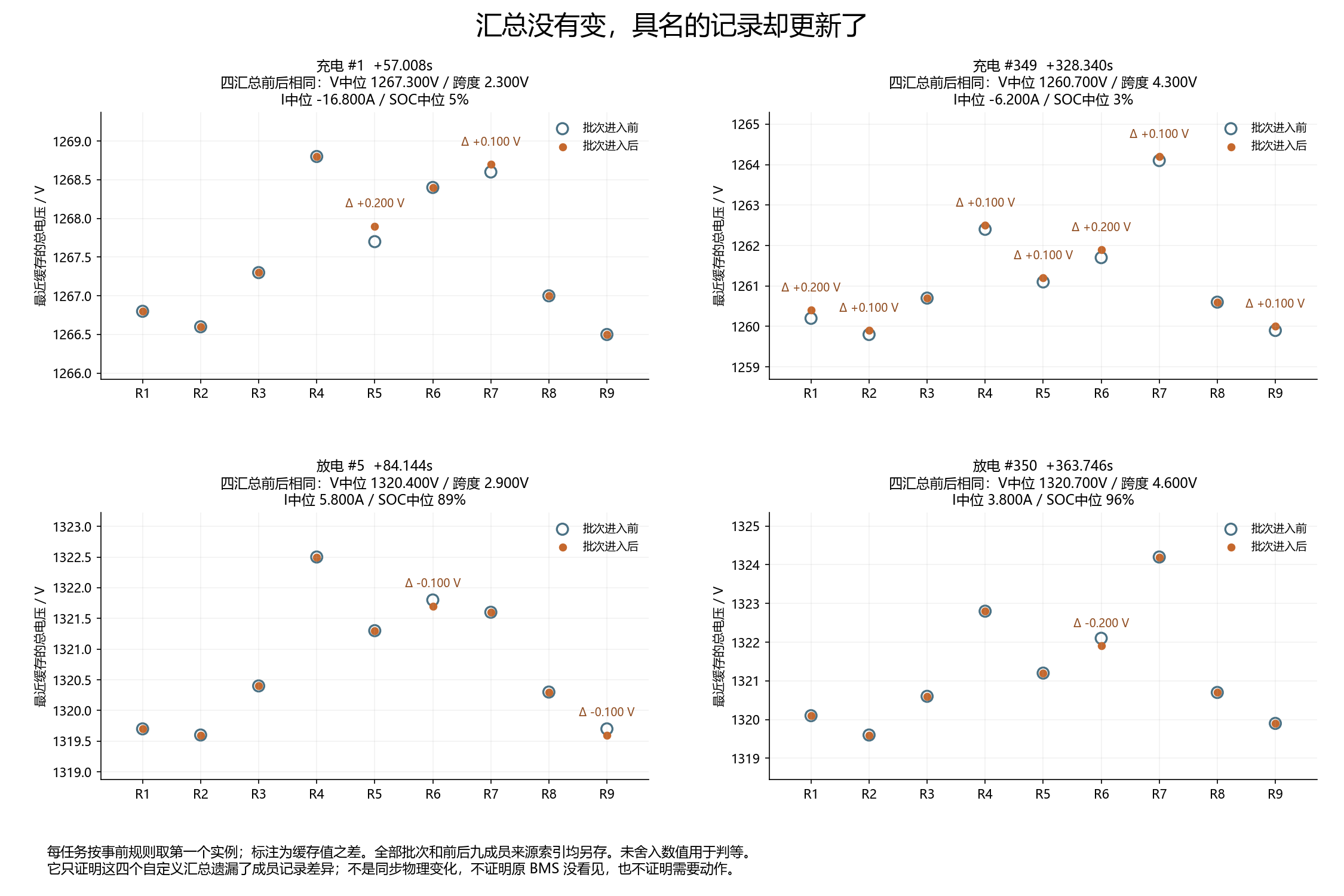
- Four previously retained summary-equality cache examples: #1, #349, #5 and #350. Only the selected before/after caches are supplied here, not these records' complete traces.
- The current-range example in the methods is accompanied by its existing member table for #195/#198. This does not add #195 to the interactive replay.
- The mixed history-reconstruction result retains the existing four-record summary table. It is historical descriptive model arithmetic, not evidence of physical memory or BMS benefit.
No raw MAT file, additional period, temperature, cell-level measurement, SOH or control log is included. Reading of the wider history is unfinished. A stored operation is a record container, not a verified physical task boundary; blanks between records are not observed rest.
Publisher coordinates
The # identifiers are LFR chronological record identifiers, not BMS commands. R1–R9 are retained rack positions; lifetime hardware continuity has not been independently established.
| Record | Publisher file | Root / operation group | Publisher MD5 |
|---|---|---|---|
| #1 | OperationCondition_202410_All.mat |
OperationCondition_202410_All/Operation1 |
81697dd0dbe62b10ef4150a4a7369eeb |
| #5 | OperationCondition_202410_All.mat |
OperationCondition_202410_All/Operation5 |
81697dd0dbe62b10ef4150a4a7369eeb |
| #130 | OperationCondition_202412_All.mat |
OperationCondition_202412_All/Operation40 |
b714eb23589997d86e34c183205bce4c |
| #195 | OperationCondition_202501_All.mat |
OperationCondition_202501_All/Operation39 |
0d35339293f2de7e3fcf4f33055622e4 |
| #198 | OperationCondition_202501_All.mat |
OperationCondition_202501_All/Operation42 |
0d35339293f2de7e3fcf4f33055622e4 |
| #222 | OperationCondition_202501_All.mat |
OperationCondition_202501_All/Operation66 |
0d35339293f2de7e3fcf4f33055622e4 |
| #276 | OperationCondition_202502_All.mat |
OperationCondition_202502_All/Operation51 |
c9a26c08e487c7560ba72b1edfc06af2 |
| #349 | OperationCondition_202504_All.mat |
OperationCondition_202504_All/Operation14 |
e519294f47ed3d5e9dffd8a844a7faee |
| #350 | OperationCondition_202504_All.mat |
OperationCondition_202504_All/Operation15 |
e519294f47ed3d5e9dffd8a844a7faee |
Records and reproduction
Positive recorded current denotes discharge; negative denotes charge. Voltage and current keep their own record times. Time axes are minutes since each record-container start; this is not a shared physical onset or a verified timezone.
The replay loads four compressed I/V archives. The files in o6_native_joint_motion_compare_v0_2_operations/ contain those archives as base64, with SHA-256 identifiers checked by the viewer. Inside an archive, channel rows are [source_index, native_ms, value, status]. Only DISPLAYED rows participate; OUTSIDE_CONTAINER and TRIMMED_SEGMENTATION_EVENT remain explicit exclusions. These archives are unchanged from the existing local display. The record index contains only the four public replay records. SOC packet keeps the original per-rack timestamp/value arrays for those same four records, without other periods.
The 3D path groups each voltage record with the latest preceding current record no more than 10 seconds old. It does not interpolate I/V or create synchronous acquisitions. Source indices, channel ages and the voltage record's age relative to the cursor are inspectable in the interface. Native I/V strips also show retained records not accepted into a group. Points are not joined across unknown intervals. Apparent screen motion depends on units, axis scales and recording support; it is not a physical rate estimate.
Each rack's Ah ledger starts at its own first retained current point. Traverse consecutive current records, integrating linearly only over positive intervals no longer than 5 seconds; divide A·ms by 3,600,000 for Ah. Split intervals at their linear zero crossing. Negative area becomes charge-in, positive area discharge-out. A new supported segment follows every longer gap. No current is supplied for missing prefixes, suffixes or gaps. Subtotals may accumulate several supported segments but never include unrecorded charge. Time coverage is not charge completeness. Ah is not capacity.
Original SOC is displayed at its own native times. First and last SOC estimates need not coincide with current or container boundaries. They are neither independently verified physical states nor a test target for a different estimator.
The two pairs were selected from 324 previously opened records using at most 2 percentage points in same-rack first SOC and 5% in duration and same-rack supported Ah. Relative difference is 2|a-b|/(a+b). The displayed pair descriptors retain the largest same-rack difference. Neither the current waveform, temperature, requested task, control, complete initial state nor intervening history was matched. See the member summary, discharge figure, charge figure and earlier public case.
Member cache examples
Example data retain the first qualifying instance in each of four records under the existing replay rule. Records enter latest-value caches in native timestamp order, batching equal timestamps. The custom summaries are median V, V range, median I and median SOC over nine members, with incomplete-member summaries refused. Equality uses unrounded stored values; display rounding does not decide equality. Cache values are not a simultaneous physical state.
Each example records the before/after four-value summary, changed rack IDs, batch coordinate, and all nine before/after voltage records as [source_index, elapsed_ms, value]. These data reproduce the displayed table and figure; they are selected examples, not a complete replay reproduction or prevalence count. The original BMS may retain these distinctions and use other protective paths; its implementation is unknown here.
Current range and history evidence
The current-range member table is the existing #195/#198 account for the navigation range 140 <= I < 150 A. The methods describe the original 5-second maximum age of preceding I at a V record. Native source indices, elapsed time, recent SOC and partial Ah remain in the table. No causal attribution follows from the co-occurrence. This table describes that historical selection, while the public viewer's interactive range has its own displayed inclusive endpoints and 10-second I/V rule; the two are not identical filters.
The history reconstruction summary retains all four records, nine racks and both 5/10-second current-support scenarios. Each rack learns separately within each record. The current-history baseline already inherits the preceding V plus current history, record intervals and source ages. The augmented model adds prior 60/300-second V-slope descriptions. Values are estimated from earlier information, scored against the arriving record, then incorporated into the update. The two order controls shuffle earlier V values while preserving the last inherited value, target, timestamps and model size. SOC is not a fitting/scoring input.
Positive response_minus_current_mae_V means the added-history variant had higher mean absolute record-reconstruction error; negative means lower. Retain both signs. The support scenarios change the trainable and scorable nodes together, not the physical sampling rate. Small error differences do not establish measurement accuracy beyond the recorded voltage resolution. This edition supplies the historical summary, not a new model run, complete historical model-code package or original-BMS comparison. No physical-memory, general prediction or control-effect claim is established.
Verification and reuse limits
This public preparation checks source hashes, byte-preserved display modules and figures, exact four-record subsetting, links and interface behaviour. It does not rerun every historical empirical builder or establish sensor calibration, physical synchrony, causal validity or independent scientific assurance. Public styling may change; the declared data, formation rules and claim-bearing content must not change silently.
Keep source attribution, selection, timestamp support and omitted-interval treatment with reuse. Report a suspected error through the website contact with the record ID, rack, source time and page location. A corrected edition should identify what changed rather than silently replacing a numerical claim. A change of use from observation to intervention needs a separate test, not stronger wording.
General observatory boundary, not an additional finding
Observation/measurement layer only. Not SOH, not RUL, not safety, not fault, not remaining-life, not warranty/underwriting/investment advice. It shows response-organisation continuity patterns visible in the named channels. Material-mechanism interpretation requires independent physical evidence (EIS / teardown / reference electrode / imaging).
This exhibit supports only the stated descriptive distinctions. It does not establish a continuity pattern, a cause, internal material change, original-BMS omission or improved control.