A battery asset owner needs to know what the asset can deliver under the next request. A compact condition summary is useful, but the path by which a battery charges or discharges may contain differences that the summary does not describe.
These examples make one limited point visible: close starting SOC records, close duration and close supported Ah do not specify the same recorded current and voltage path. Whether preserving those paths improves a particular operational decision remains to be tested. SOH is not compared in this case.
Observed
The figures retain all nine racks across each complete retained period. Their dots are records, not a continuous or synchronized picture of the physical battery. The examples were selected after inspection; they are not a representative sample.
| Pair | Maximum first-SOC difference, same rack | Container-duration relative difference | Maximum supported-Ah relative difference, same rack |
|---|---|---|---|
| Discharge #130 / #198 | 1 percentage point | 0.87% | 1.63% |
| Charge #222 / #276 | 1 percentage point | 0.70% | 0.66% |
Relative difference is 2 × |a − b| / (a + b). “Supported Ah” is only the integral over specified recorded-current intervals; it is not full transferred charge or capacity. The underlying query allowed at most 2 percentage points in first SOC and 5% in each of the other two comparisons.
Discharge: the amount does not specify its timing
Record #130 (18 December 2024) lasts 128.25 minutes; #198 (17 January 2025) lasts 129.37 minutes. Yet their current paths differ visibly. In #130, an earlier lower-current plateau precedes an increase. In #198, the higher-current portion arrives earlier, with current stepping down later. During that later part, the retained voltage records turn upward.
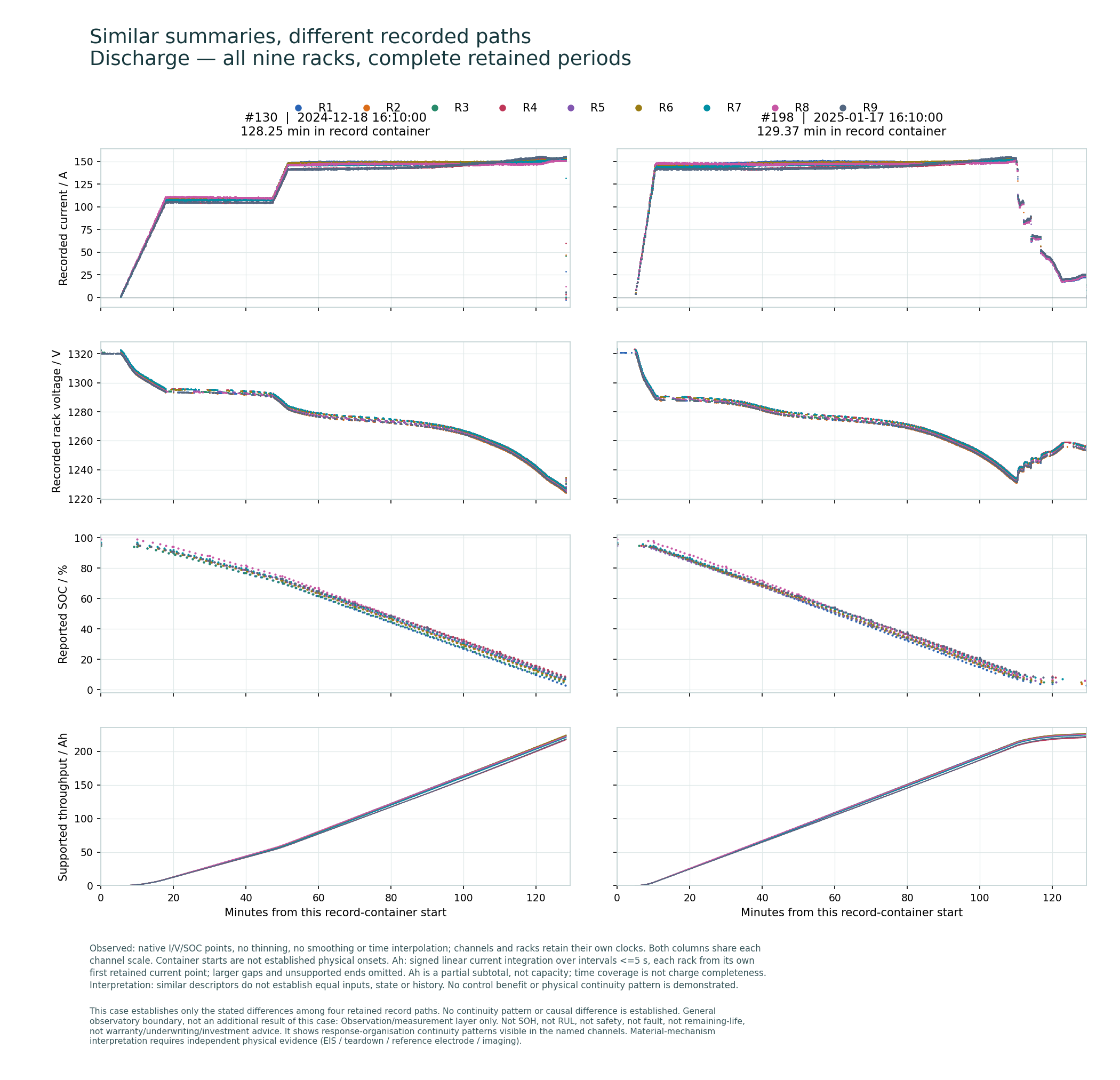
Read the current row before interpreting the voltage row. The realized current histories are different. This is not evidence that an identical input produced a different battery response, and it does not isolate aging, a material mechanism or a controller decision.
Charge: keep the members and their timestamps
Records #222 (30 January 2025) and #276 (17 February 2025) also meet the three proximity rules. The full plots preserve the late current separation among racks and the member-specific reported SOC records rather than reducing either period to a single endpoint.
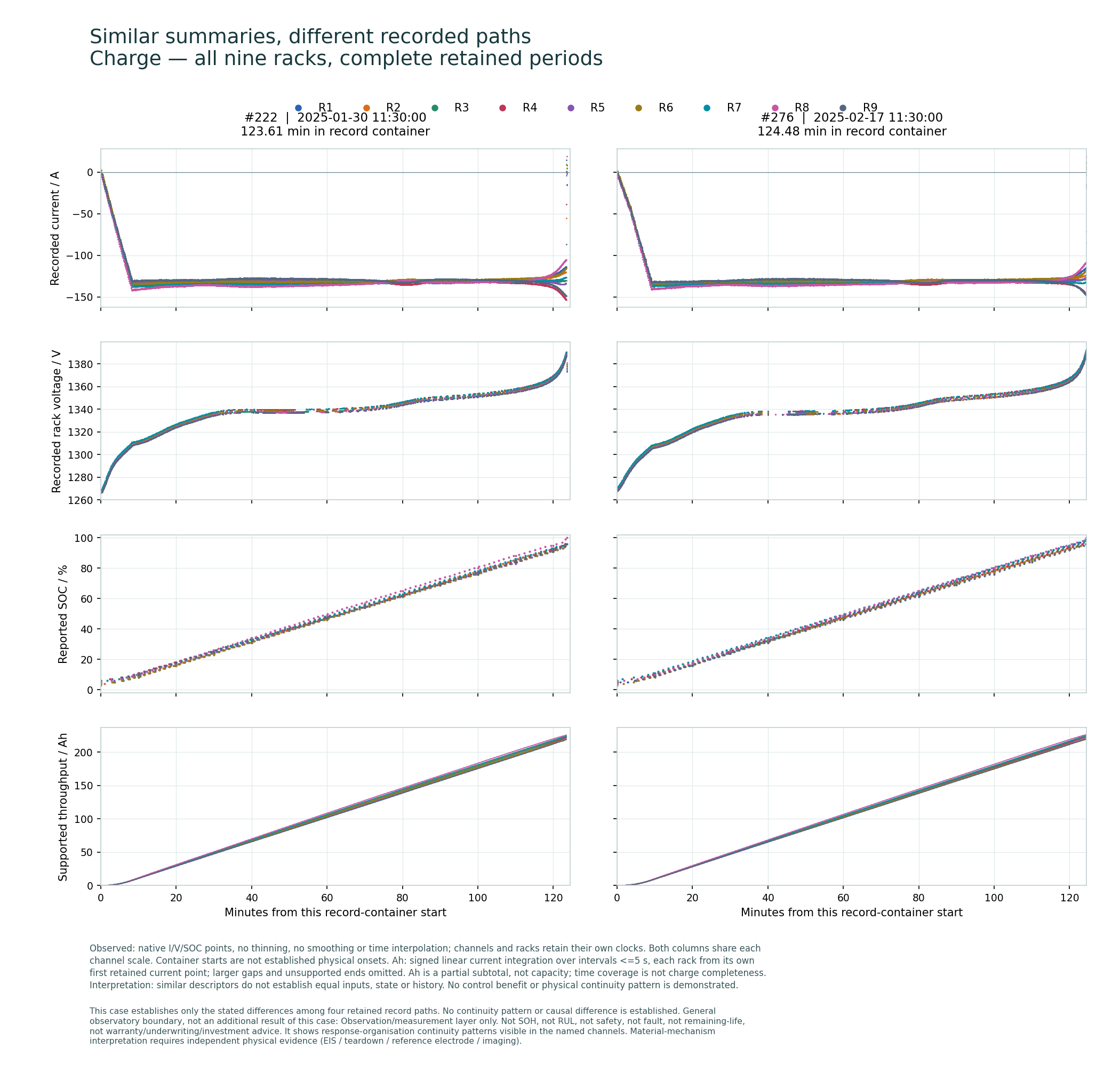
One concrete example is R3: its first-to-last reported SOC is 4→95% in #222 and 5→100% in #276, while its supported charge-in subtotals are 222.32 and 222.97 Ah. However, the last SOC record is 38.5 seconds before the container end in #222 and at the container end in #276. These are not synchronized terminal states, a capacity measurement or proof of SOC error.
This timestamp qualification matters throughout the case: in #198, the last SOC records for R3, R4, R5, R7 and R9 precede the container end by more than six minutes. The member table retains every member, both SOC timestamps and the omitted-time accounting.
Interpretation: why an asset owner might care
A difference becomes operationally useful only if it changes a specified judgment. The present case motivates three tests; it does not answer them.
| Asset question | What retaining the path makes possible | What is still needed |
|---|---|---|
| Can this request be sustained for the required period? | Inspect when current changes, how voltage responds, and which members differ during the period. | Requested power/current, actual limits and modes, aligned measurements and an explicit delivery criterion. |
| Why did the realized operation change or end? | Locate the change in the retained channels instead of attributing it to the endpoint summary. | Requests, limit reasons, alarms, PCS/BMS actions and termination records. |
| Does an earlier passage help interpret the next one? | Preserve member identity and the order of responses for a prospective comparison. | Comparable conditions, the missing intervening history, and evaluation using only information available at each decision time. |
For example, an owner might ask whether member histories help distinguish two requests that look alike in a summary but later differ in delivery. A valid test would compare a summary-only observer with one retaining the specified member history, against a predeclared observable outcome, without using future records. It must also check whether the existing BMS already retains equivalent information.
The original BMS strategy is not available here. These plots cannot show that it ignored the differences. Nor do they establish extra revenue, longer life, a safe limit, a fault, or a reason to change dispatch. Weihai is not a second-life validation dataset; that application would need its own evidence.
How to read the evidence
- Time: each panel starts at its record-container boundary, not a verified physical onset. Gaps between containers are not observed rest. Native timestamps are retained; a timezone has not been established.
- Current and voltage: plotted at their own retained sample times, without smoothing, thinning or interpolation. Positive current denotes discharge; negative current denotes charge.
- SOC: the dataset’s reported estimate, not independent physical ground truth. Its first record need not coincide with the first current record; its last record need not reach the period end.
- Ah: each rack starts from its own first retained current point. Only adjacent current intervals no longer than 5 seconds are integrated, assuming linear change and separating charge from discharge at zero crossings. Larger gaps and unsupported prefixes/suffixes remain uncounted.
- Support: the partial Ah curve does not account for current in omitted intervals. Time coverage is not charge completeness. The downloadable records preserve the supported segments.
- Comparison: neither response waveform, temperature, actual request, control action nor prior history was matched. The three proximity rules are a way to choose examples, not proof of equal physical conditions.
Check the case
Member summaries and timestamp support · Plotted records and integral support · Source, method and reuse notes
The data originate from Qu, Jingbo (2026), Dataset for: A Multi-Agent AI Framework for Explainable Battery System Maintenance. These figures and examples are an LFR re-presentation, not an endorsement by the dataset author.
If a source value, timestamp or formation rule changes, the affected statement must be checked again. If the use changes from describing records to selecting actions, this case is not a substitute for that further test.
This case establishes only the stated differences among four retained record paths. No continuity pattern or causal difference is established.
General observatory boundary, not an additional result of this case
Observation/measurement layer only. Not SOH, not RUL, not safety, not fault, not remaining-life, not warranty/underwriting/investment advice. It shows response-organisation continuity patterns visible in the named channels. Material-mechanism interpretation requires independent physical evidence (EIS / teardown / reference electrode / imaging).