01 / Looking for yourself
Inspect the three moments.
Compare the named currents, their difference and the available voltage points. If the interpretation does not fit what you see, follow the source times and rows.
Go to the time buttons →Weihai / One charging record / Nine racks
The overall current level—or whether the named members keep the same relationship?
If you use operating summaries to review a battery, this distinction matters to what you can ask of those summaries. A broad “steady” label does not tell you which rack’s recorded current was larger at each point along the way.
Here, two members change order and change back inside a steady-looking charging platform. Follow three moments, inspect the records, and decide whether your own summaries leave a similar question open.
Observed · 01 / Keep the whole passage
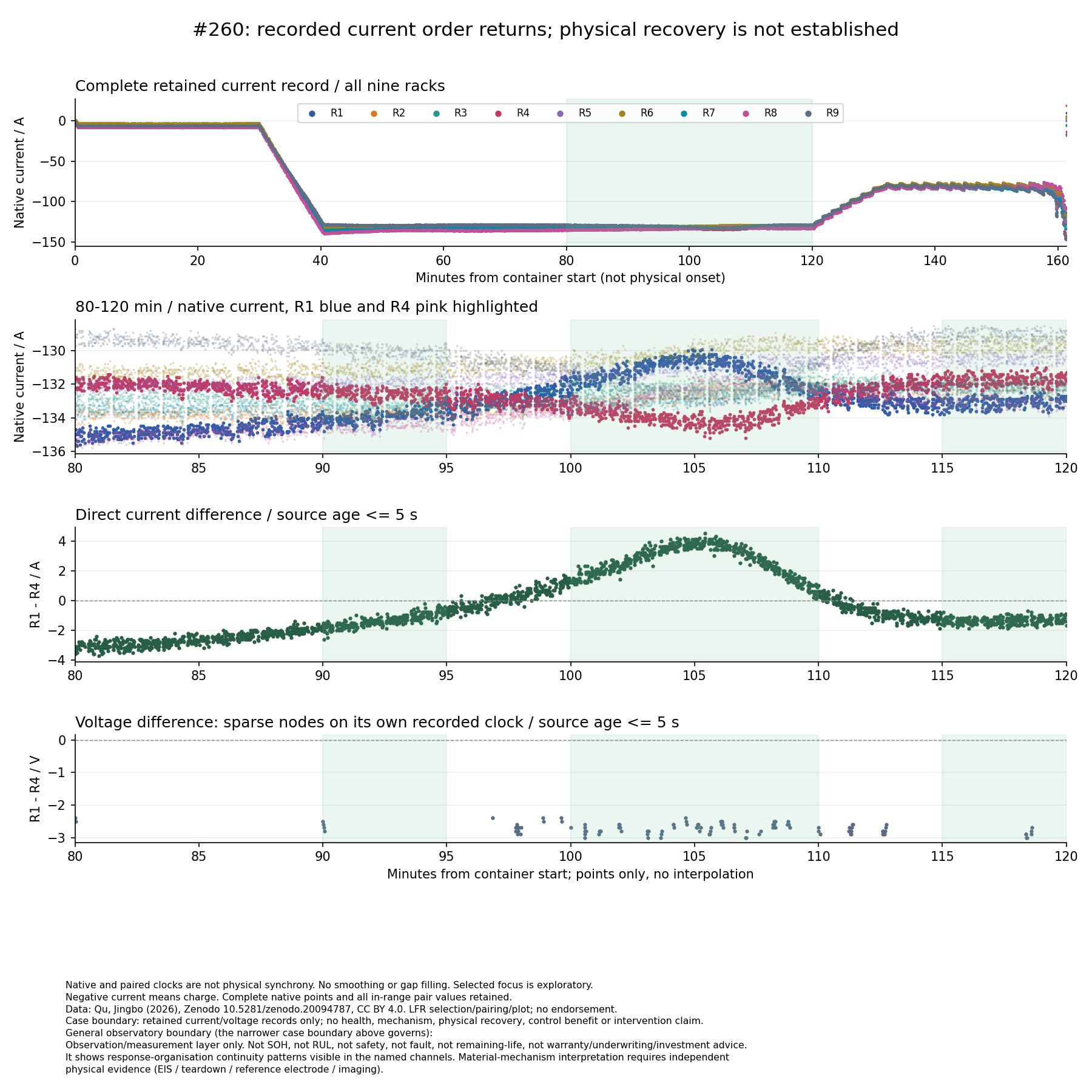
The complete retained current record is below. The shaded 80–120 minute interval was chosen for a closer look after the full record was inspected. It sits inside a broad charging platform. It is not the whole charging history.
Time everywhere on this page means minutes from the record container’s start—not a verified physical onset. Blank support is not zero current or rest. How the record became this view →
Observed · 02 / Check the change yourself
Watch R1 (blue) and R4 (pink) in the current panel, then follow their direct difference below it. Switch back to the full record to see where this movement sits. You can also change the source-age screen and inspect the source times beside the cursor.
The sequence is R1 → R4 → R1: which of these two has the larger charging-current magnitude, while both recorded currents are negative. It is neither a health ranking nor evidence that a controller assigned a role.
Source age is the time between a contributing source row and its comparison node. Changing this screen changes eligible difference points; the native-current panels keep their original rows.
The overview above always stays complete. The close-up includes 80 min and excludes 120 min, matching the table's interval convention. All values inside that range are shown; vertical scales adapt to it. The three charts below share their horizontal axis, not a common acquisition clock. Open a static four-panel reading.
Below zero: R1 is more negative. Above zero: R4 is more negative. The difference uses the two members directly; it does not depend on a moving nine-member median. During end-of-record sign changes, use the raw values rather than this charging interpretation.
At the main ≤5 s screen, the close-up has 114 voltage pair nodes, all with R1 below R4. There are none in 85–90 min. Those points do not establish what happened between them, constant voltage, synchrony or decoupling.
Pointer or slider selects the nearest retained node within 5 s of the cursor; otherwise “no nearby node”. No value is carried across a gap. This inspection radius is only a display rule, separate from the source-age screen.
Observed · 03 / A small table, with its support
All retained current pair differences in the first and last rows are negative; all in the middle two are positive. The same-recorded-timestamp subset preserves those signs. This checks the recorded ordering, not physical synchronisation.
| Container minutes | Nine-member C / A | R1 − R4 / A | Pair nodes ≤5 s | Same-timestamp nodes |
|---|---|---|---|---|
| 90–95 | −132.8 | −1.4 | 269 | 195 |
| 100–105 | −132.3 | +2.7 | 274 | 220 |
| 105–110 | −132.0 | +2.9 | 274 | 210 |
| 115–120 | −131.9 | −1.4 | 275 | 212 |
C is the median of nine recorded currents, not total current, external demand or a share. Values are five-minute node medians rounded to 0.1 A, not time-weighted means. C and the direct pair have different eligible node sets. Reused source rows are not independent measurements.
The intervening 95–100 and 110–115 minute bins contain both signs. Their boundaries are not exact crossing times. Across 80–120 min, five-minute current-difference medians agree between the ≤5 s and ≤10 s screens.
Interpretation · 04 / What did the return mean?
“The order came back” is a narrower statement than “the battery came back”.
The direct current ordering returns inside this record. That does not show a return of the full state, the same current difference, or the same future capability. The earlier 80–85 minute difference has a median near −2.9 A; the later 115–120 minute difference is near −1.4 A.
Interpretation / What could be lost?
The nine-member median does not identify which member followed which path. It cannot, on its own, reconstruct this R1/R4 exchange of order.
Seeing the same order before and after can leave the reversal between them unseen. “R1 is larger again” does not mean “nothing changed in between”.
The immediate loss is the ability to distinguish these passages.
If the member records remain available, you can return to them. If only a summary remains, that summary does not recover the omitted member history.
Information loss is not evidence of operational harm. This case does not establish damage, shorter life, lost revenue or unsafe operation. Nor does it show that the original BMS ignored these records. Whether retaining this distinction improves a particular decision is still a question to test.
A possible next step / Observation before intervention
When a system describes a record as “steady charging”, which relationships does that judgement cover? Are member-level changes also retained, interpreted or acted on?
You may have seen this exchange of order before. How would you tell whether it is a familiar pattern for this system—or whether the familiar pattern itself is changing?
“Familiar” means previously observed under comparable conditions, not known to be healthy or safe. This single case does not establish that history, or how the original BMS described or handled it.
Explore the engineering questions →Open questions / Following the relation further
These are possible lines of enquiry, not explanations established by this case. Each needs its own supporting records; the available current and voltage view does not answer them all.
How do the two branches’ charge states and polarisation responses change as charging progresses? What evidence would distinguish these possible contributions?
This page does not reconstruct internal state. Reported SOC, if available in a later comparison, remains an estimate rather than an independent answer.
Do connection resistances, busbar connection positions or temperature conditions differ? Are the racks directly connected to a common bus, or connected through separate converters?
The wiring and measurement arrangements would need to be established before assigning a cause to installation.
Did current limits, balancing, contactors or other control states change at the time? Does the original system already retain and use these member-level differences?
An observed current change is not, by itself, a record of a control command. These questions do not assume that the BMS missed the relation.
Does this pattern reappear when comparable conditions return? Is it present throughout the available history, or first seen later? Do its timing, duration, size or return path change?
Keep recording gaps and changes in measurement visible. A first recorded appearance is not necessarily the physical beginning of a change.
For whichever question you pursue, ask: which record could distinguish the explanations still possible? If that record is unavailable, leave the question open.
Open questions / Not a diagnosis
Battery differences, electrical connections, control and measurement may contribute. The sensor placement, calibration, acquisition order and controller behaviour needed to separate these explanations are not established here. No mechanism is selected.
This is one exploratory record. It does not establish a recurring pattern, a normal baseline, poor health or recovery. The record was reached chronologically; the pair and close-up were selected after seeing its complete plots.
Methods, source and limitationsDownload plotted recordsDownload table values