#130 / #198: two discharge records, nine members
Two retained paths on shared scales. Replay each one, or highlight a current range within existing records. Inspect how members unfold and what still differs when recorded current is close.
Only the four case records (#130, #198, #222, #276) are included in this public replay. No other periods or catalogue entries are loaded. Default pair: #130 / #198. All nine racks are retained. “Complete” refers to the stored record, not the physical history.
Selected after inspecting the records. Three declared record coordinates are close; complete initial states and intervening history are not matched. These four records, including the same record on both sides, remain selectable.
Drag to rotate; wheel or pinch to zoom; Shift-drag or right-drag to pan. Both windows share the camera and scale; time cursors are independent. Equal playback speed does not mean the same physical stage.
The range uses the native I referenced by each point, even when displaying ΔI. Other points are dimmed, not discarded. Similar current is not equal temperature, history or synchronous current across all racks. Reported SOC and partial Ah accompany the I/V view without filtering it. Ah integrates linear current only over intervals ≤5 s. Same Ah is not the same SOC or physical stage.
At the two cursors, what did each member last record?
Each row uses the latest qualifying I/V group before the cursor. I may precede V by at most 10 s; the age of V relative to the cursor is listed separately. Missing values are not zeros, and caches are not a shared synchronous physical state.
| Member | A · I / A | A · V / V | A · V age / s | A · I before V / s | B · I / A | B · V / V | B · V age / s | B · I before V / s |
|---|
Three different questions
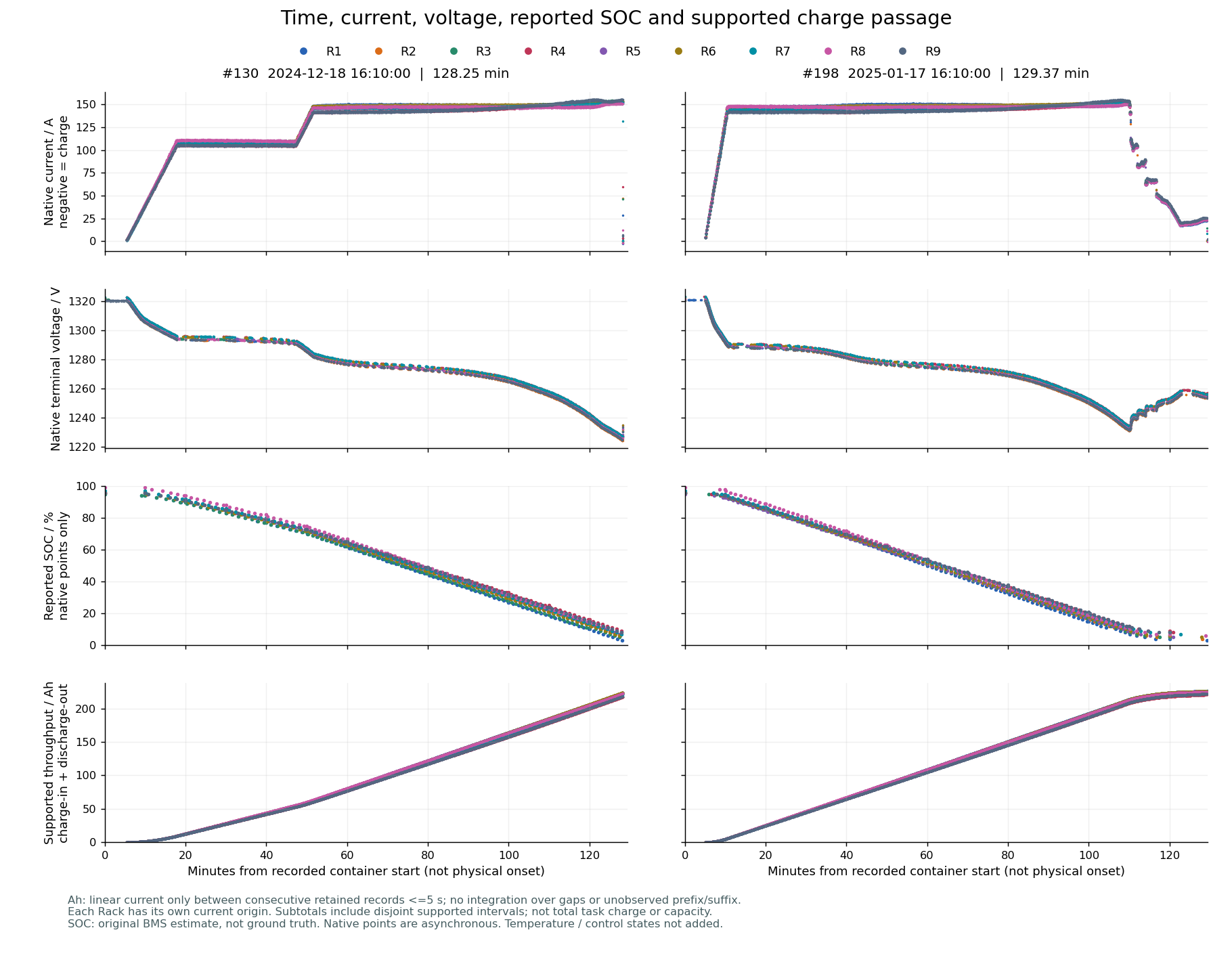
Time: how long does this record span? Ah: how much charge is accounted for over supported current intervals? SOC: what position did the original BMS report at its own record times?
For illustration only, ideal constant current of 100 A for half an hour and 50 A for one hour both give 50 Ah. This is a units example, not either displayed record. Equal charge passage does not make intensity, duration, initial state or voltage path equal.
Ah does not assume a 300 Ah capacity or invert SOC. It shares its source with I and is not independent evidence. The inherited 5 s limit bounds the permitted linear approximation; it does not guarantee integration accuracy. Longer gaps are not integrated; prefixes, suffixes and inter-record gaps are not filled with zeros. Accumulated subtotals across gaps still contain only accounted intervals.
SOC is shown as native points, with record age. No staircase, interpolation or revision of reported SOC is added. First SOC is the first visible estimate, not ground truth; a recorded step size is not estimator accuracy. Temperature is not loaded.
Comparison, not an automatic verdict
Observed: Display groups use the inherited 10 s I/V rule, retaining named members, native times, source row indices and source ages. Reported SOC and supported charge subtotals keep their own times. No new diagnosis or history-change result is formed.
Interpretation: Apparent motion depends on channel units, display scales and record support. Faster movement on screen is not directly a greater physical rate. A current range or SOC value alone cannot establish equal complete states.
This English edition changes labels and layout only. It reuses existing archives; it does not read raw MAT files or add temperature, cell, control, barrier or sealed measurements. The original analysis, source data and Chinese viewers remain unchanged. Positive I denotes discharge; negative I denotes charge. Observation only: no diagnosis, SOH, RUL, safety, material mechanism, capacity, BMS benefit or control advice.
Methods, static comparison and check scope
Full English methods · Full-span static comparison · English edition notes · Replay formation rules
The public packet retains the original display calculations and a restricted record catalogue. File checks do not establish measurement accuracy, synchronous acquisition or the validity of a physical interpretation.
General observatory boundary, not an additional finding
Observation/measurement layer only. Not SOH, not RUL, not safety, not fault, not remaining-life, not warranty/underwriting/investment advice. It shows response-organisation continuity patterns visible in the named channels. Material-mechanism interpretation requires independent physical evidence (EIS / teardown / reference electrode / imaging).
This exhibit supports only the stated descriptive distinctions. It does not establish a continuity pattern, a cause, internal material change, original-BMS omission or improved control.