From State Summaries to Response Paths
A Traceable Observation Workflow for Field BESS Records: The Weihai Case
English web reading edition v0.1 · 25 September 2026 · Descriptive methods demonstration; not peer-reviewed.
This English methods account accompanies the interactive exhibit. It reuses existing records, methods and figures. Public preparation adds no measurements or experimental recomputation and does not extend the interpretation. Source and method identifies the dataset, transformations, included evidence and reproduction limits. The local draft is retained unchanged; this web edition replaces local links with the declared public evidence subset.
- From State Summaries to Response Paths
- A Traceable Observation Workflow for Field BESS Records: The Weihai Case
- Abstract
- 1. The question: what does a summary represent?
- 2. What the data can observe
- 3. Method: retain a route from summary to process
- 4. Observed: demonstrations in existing records
- 5. Interpretation: what do these observations add?
- 6. Limitations and unfinished work
- 7. Closing
- References and supplied evidence
Abstract
Field battery records are often compressed into state estimates, interval statistics or health features. These representations are useful, but similarity in a summary does not make the member records and processes that produced it identical. Using existing records from nine racks in a Weihai battery energy storage system (BESS), this methods case presents an observation workflow that retains member identity, native timestamps, visible current passage and missing intervals. It starts with the full retained record, then examines specific relations, preserving a route from each summary back to the records that formed it.
Existing examples show two distinctions. Named-member voltage caches can change while a custom summary remains exactly the same. Current and voltage paths can differ when first reported state of charge (SOC), retained duration and supported ampere-hour subtotals are close. A further current-range comparison shows that similar current does not automatically establish the same stage of progression or a comparable state. A history-replay experiment with mixed results is also retained, separating “preserving distinctions” from “improving a judgement with those distinctions”.
The contribution offered here is an inspectable record-reading workflow with concrete examples, not a new battery-health criterion. It does not identify internal material mechanisms, prove that the original battery management system (BMS) overlooked member information, establish control benefits or reconstruct a complete physical history.
Keywords: field energy storage; asynchronous records; member identity; process paths; state summaries; observation boundaries.
1. The question: what does a summary represent?
If two charge or discharge records have similar starting SOC, duration and accumulated Ah, they are close on those coordinates. Further questions remain: does current rise early or late? How long is the higher current sustained? Where do member voltages begin to separate? Are there any retained records after an upward turn?
Those questions cannot be answered from the summaries alone. A summary is not necessarily erroneous data. It is a particular compression of a process. What needs qualification is the kind of similarity that the compressed representation supports.
The question is:
When field BESS records are compressed into state summaries, which member and process differences cease to be visible? How can those distinctions be retained without interpreting the records as physical facts they have not established?
“Method” here means an observation and evidence-organisation workflow. It is not a new score replacing SOC or SOH, nor a claim that drawing more curves makes an analysis superior to existing algorithms.
2. What the data can observe
2.1 Object and scope
The public Weihai dataset comes from an operating energy storage system. This document reuses rack current, terminal voltage and, in selected cases, original BMS SOC records already extracted and retained by the project. Members are distinguished by their recorded identities, R1–R9. The observation unit is each member's retained process within the same system. Racks are not treated as independent battery samples, and individual points in a long record are not treated as independent experiments.
The release is partitioned into charge/discharge operations. Here these are called “retained segments” or “records”, avoiding the implication that physical task onset, termination and the intervening history were fully observed. File month, record-container boundaries, each channel's timestamps and physical action boundaries are not equivalent. No unrecorded experience between containers is reconstructed. [S1][S2]
Only previously analysed material is reused. The interactive public replay contains four selected records, not the full dataset. Record-by-record reading of the full open range remains unfinished. The cases were selected after exploration; they are not a blind validation set and do not estimate the prevalence of a phenomenon across the dataset. [S9]
2.2 Channels and coordinates
| Record or coordinate | Use here | What it does not automatically represent |
|---|---|---|
| Rack current I | Recorded actual current; negative for charge, positive for discharge | External requests, original BMS decisions or the complete unrecorded current history |
| Rack terminal voltage V | A terminal-voltage projection retained at native timestamps | Internal material state, member health or a synchronous whole-system state |
| Original BMS SOC | A reported estimated coordinate, with source time and record age | Independent ground truth, remaining energy or the validation target for a different observation method |
| Ah subtotal | Integration over declared intervals between adjacent current records | Capacity, all charge that passed or a common physical progression coordinate across members |
| Time since record start | A navigation coordinate within the stored record | Known physical onset or continuous operating duration |
| Gaps within or between records | Lack of record support for that channel | Zero current, rest, no change or physical recovery |
The materials used here do not supply a complete chain of external requests, current limits, balancing, contactor actions and termination decisions. Temperature is not used in common matching or attribution in the cases below; this does not mean temperature is unimportant. The separate contributions of the battery, environment, control and measurement cannot be isolated here. [S1][S2][S3]
3. Method: retain a route from summary to process
Existing retained records and their sources
        ↓
Member identity, native timestamps, support and gaps
        ↓
Current–voltage paths across the full retained segment
        ↓
Declared comparison: what is close, different or unknown
        ↓
Member distances, ordering and locations of change
        ↓
A bounded description + explanations still open
This is a reading sequence, not a new data-generation chain. It does not imply that every example implements every step.
3.1 Keep each channel on its own clock
Every value used should retain at least record identity, rack, channel, source row index, source time and value. If a display cursor uses the latest preceding record, its age should also be retained.
A set of values at one display cursor is a collection of records selected by a rule. Its source times may differ. It cannot simply be called the common physical state of the battery at that instant. Connecting points, interpolating or using finer playback steps does not increase the temporal resolution of the original observations.
3.2 Show the full retained segment before inspecting a detail
First show the native paths of every member retained within the container, then mark local spans. A detail view must lead back to the full record so that its lead-in, subsequent records and missing intervals do not disappear from interpretation.
“Full” always means the full retained span, not a complete continuous physical experience. Use interpretable shared plotting scales across records. Do not stretch unequal durations into a common percentage and silently call it the same physical progress.
3.3 Declare the comparison conditions
“Similar records” must specify the coordinates on which similarity is defined. Direction, first records, actual current paths, elapsed duration, visible charge subtotals, the SOC coordinate and record support should be recorded separately as relevant to the question. Unobserved conditions remain unknown.
Matching a subset of conditions can support a descriptive comparison under that subset. It cannot establish identical complete initial states or causal attribution. Nor must every unknown be resolved before looking at a figure: an unknown limits only the conclusions that depend on it.
3.4 Put summaries beside their member records
Let C(t) be a member cache formed in archive-time order using only preceding records, and let S(t)=g(C(t)) be a declared summary. We inspect whether there is an instance with:
S(a) = S(b), while the named-member voltage caches C_V(a) ≠ C_V(b).
Such an instance shows that g is not a unique representation of the retained member records. It does not establish that a and b are synchronous physical states, or that the cached difference requires intervention.
Member relations should retain distance as well as ordinal position, together with the sources of both operands. For example, D_ij = V_i(t_i) − V_j(t_j) must retain t_i, t_j and the acceptable record-age rule. It must not silently become an unknown synchronous physical voltage difference. When order changes near a quantisation step, measurement and asynchronous recording remain possible contributors.
3.5 Account for charge passage only over supported intervals
The process cases below inherit an existing Ah rule: integrate only between consecutive retained current records separated by no more than 5 seconds, assuming linear current within each interval. Split charge-in and discharge-out when current crosses zero. Do not integrate across larger gaps or fill unobserved prefixes, suffixes or inter-record blanks. [S3]
Each rack's ledger begins at its own first retained current record. A subtotal can accumulate disjoint supported intervals, but the omitted intervals must remain identifiable. The 5-second parameter is an existing display scenario, not a guarantee of physical integration accuracy.
3.6 Separate visibility from practical benefit
Member identity makes some distinctions locatable. Full retained paths make the location of differences within a process visible. Neither automatically improves estimation, warning or control.
A claim of improvement for a particular judgement requires a separately declared target, baseline, usable past information and evaluation scope. Until then, “more information” cannot substitute for utility testing. The existing result that did not show universal improvement is retained as an example of this limit.
4. Observed: demonstrations in existing records
4.1 Identical custom summaries, different named-member records
An existing offline replay uses charge records #1/#349 and discharge records #5/#350. Native I/V/SOC records enter a cache in archive-time order; records with the same timestamp enter as one batch. The fixed summaries are median V, V range, median I and median SOC across all nine members. Incomplete channel coverage is not replaced with a partial-member summary. Equality uses unrounded values. [S4]
Each of these retained segments contains an instance in which the summary is unchanged while one or more named voltage-cache values change. Figure 1 shows the first qualifying instance in each segment under the existing rule, not the largest difference.
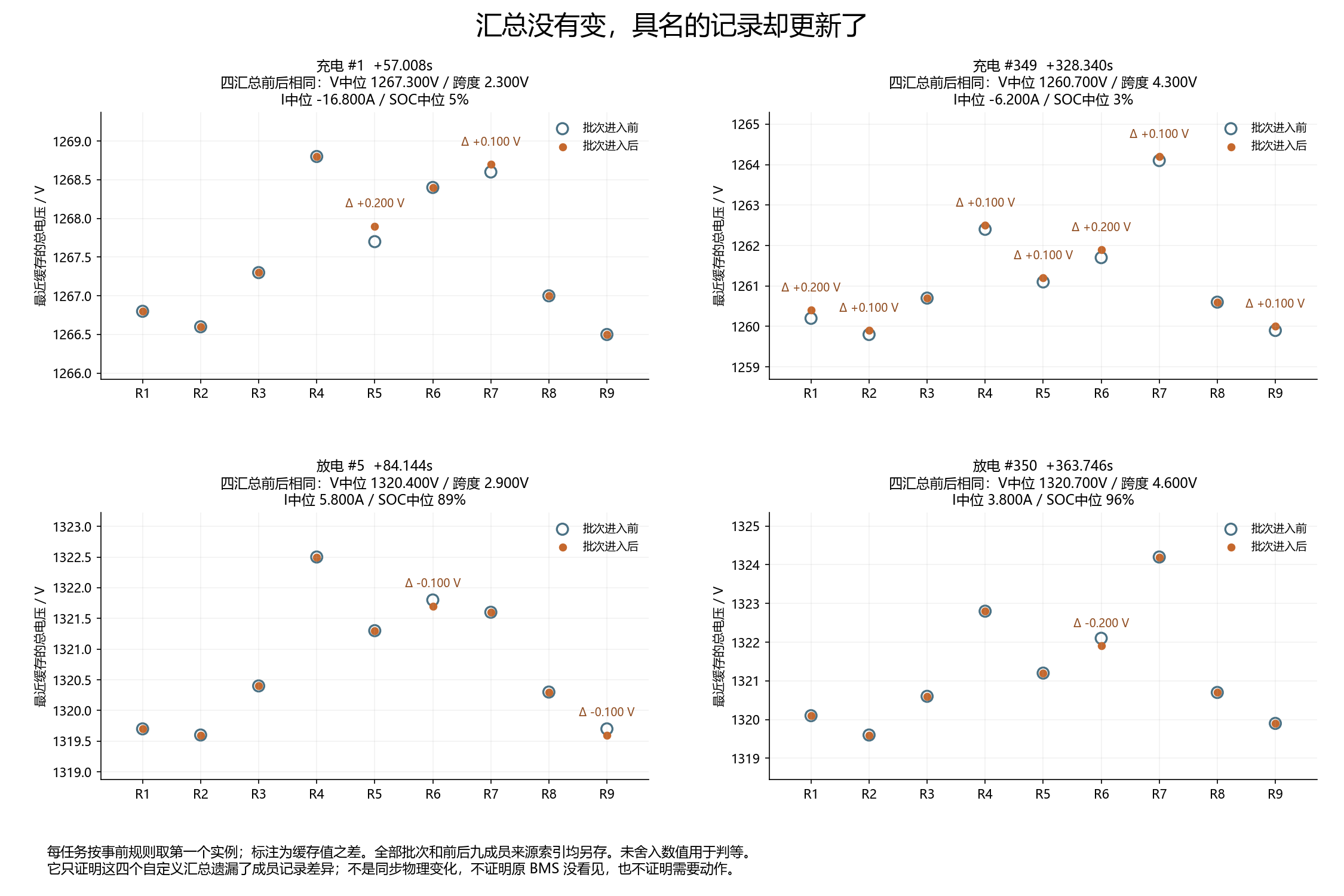
Figure 1. Open circles and filled points denote the cache before and after a record batch enters. Each value is recoverable through its named member, source index and timestamp. Display decimals do not determine equality; unrounded values do. This is a comparison of cache representations, not a synchronous physical-event plot or a comparison with the original BMS implementation.
The narrow observation is: this custom summary does not uniquely represent the named-member voltage records it compresses. The original BMS may use member channels and other protective paths. Its internal implementation was not tested here.
4.2 Similar summaries, different realised paths
An existing case selects discharge records #130/#198 after inspecting open records, with charge records #222/#276 retained as a second example pair. The selected coordinates are each rack's first SOC, retained duration and supported Ah. Temperature, control, full history and current waveform were not matched. [S5]
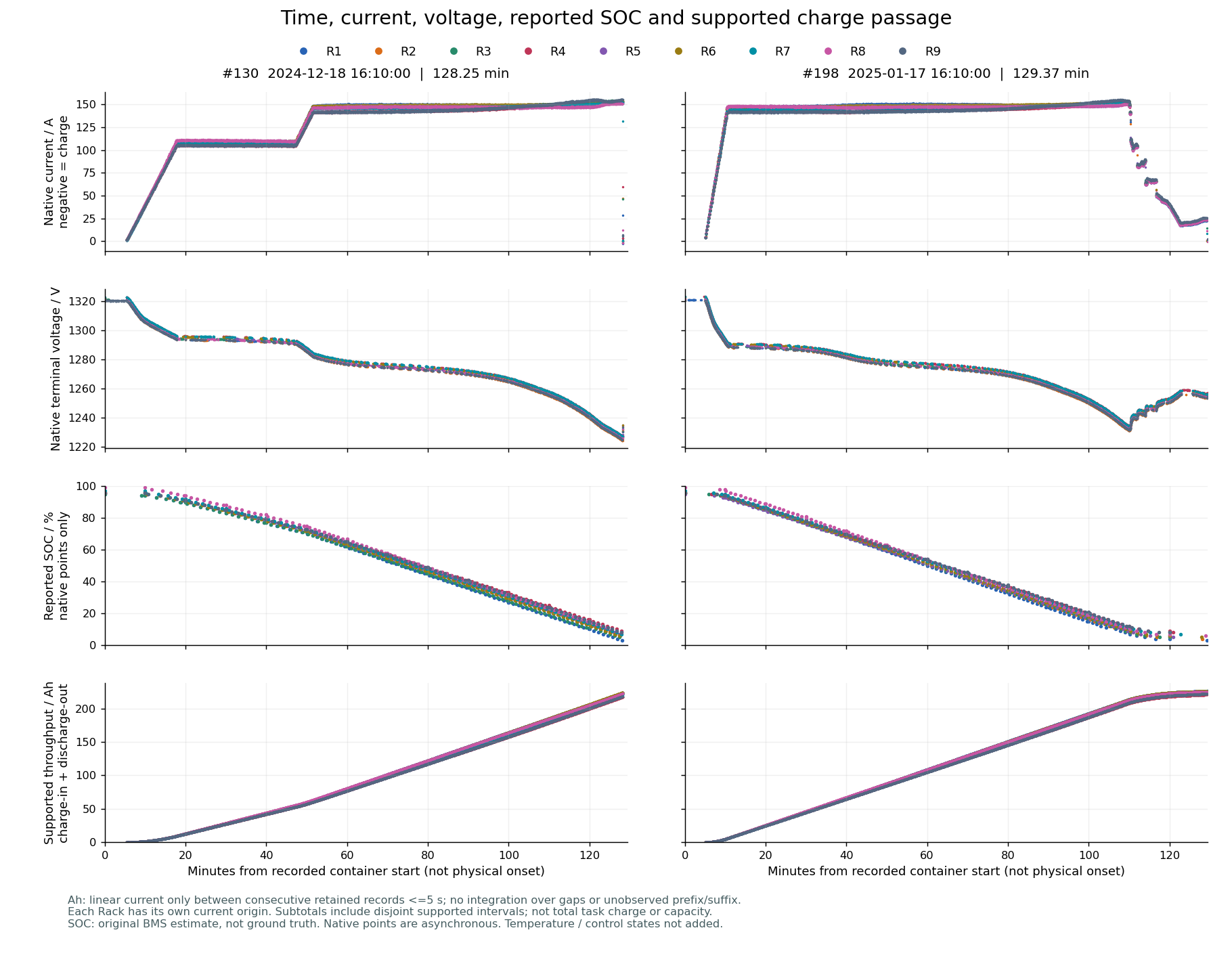
Figure 2. Each column retains I, V, reported SOC and supported charge passage for all nine members. Time is minutes since the stored record's start. Ah is not capacity; SOC is not independent ground truth. Overlapping native points do not imply continuous observation between them; the rows are not synchronous acquisitions.
In #130, current holds at a lower level before moving to a higher level. In #198, current reaches the higher level earlier and steps down near the end while voltage records move upwards. These differences are visible in the retained paths but are not uniquely determined by the selected summaries.
Actual current itself differs here. The case establishes that similar summaries are insufficient to confirm identical processes. It cannot establish that the physical battery changed under identical inputs.
4.3 A similar current range is not the same point in the process
An existing #195/#198 comparison fixed the navigation range 140 ≤ I < 150 A before computation, while retaining other bins and the full paths. Support within this range occurs at different locations in the two records, with different elapsed container times, supported charge subtotals and reported SOC positions. [S6]
That case also retains voltage-difference paths for every member pair. Different full paths do not imply that every relative order reverses. Preserved order does not imply unchanged spacing or process.
“Current is close again” can open a comparison; it does not complete the condition check. Joint changes in visible conditions do not identify the causal contribution of any one of them.
4.4 History did not universally improve record reconstruction
An existing member-history replay learns separately within each rack and retained segment. It estimates the current V record from information available beforehand, then reveals that record and updates. It compares a current-history baseline with representations that add recent V history, retaining history-order perturbations and alternative record-support scenarios. [S7]
The results do not support a conclusion that adding history is universally better. Improvement and worsening coexist. Some comparison directions reverse when record-support filtering changes. That filtering changes the trainable and scorable nodes together, so a reversal cannot be attributed solely to record-update speed.
This is a local, retrospective reconstruction of records at the same nodes. It is not an original-BMS performance comparison or a prospective deployment validation. It does not test the control value of the entire workflow presented here. Whether a particular history representation helps must be tested for a particular question.
5. Interpretation: what do these observations add?
5.1 A bounded, inspectable conclusion
In the selected Weihai records, retaining member identity, native record support and full paths lets us locate some record differences that selected summaries do not uniquely represent. Those differences have not been established as changes in internal state or as grounds for improved control.
Locating these differences depends on the original records still being retained. It is not recovery of lost information from summaries. Many-to-one compression is not a new discovery here. The demonstration concerns how this occurs in actual asynchronous BESS records and how to avoid silently changing the object being compared.
5.2 Relation to existing research and tools
The field-BESS preprint by Wong and colleagues extracts and normalises health features per cell group, explicitly accounting for operating conditions. Its Gaussian-process model adds an operating-condition term and a time term and declares an independence assumption between them. [R1] This document does not test that model or use its data. One resulting question is whether a member's response to operating conditions changes with historical position, and whether operating-condition/history interactions deserve a separate test. This remains a question, not an established finding here.
TWAICE product material already describes investigation using member-level historical curves, metrics and anomalous conditions. [R2] This document therefore does not claim that other teams look only at summaries or ignore processes. The proposed contribution is an inspectable connection among summaries, member paths, record support and bounded interpretation. Academic novelty still requires a fuller related-work comparison.
5.3 Possible practical relevance
The workflow can help formulate more specific checks: is the same spread formed by the same members? Does the same SOC representation accompany different recorded current histories? Does a local change occur within a well-supported interval or at a record boundary?
Such questions may change what should be observed or checked next. They do not themselves produce current-limit, shutdown, balancing, maintenance or replacement recommendations. Establishing those uses requires corresponding action records, an evaluation target and validation. Richer graphics do not supply that missing step.
6. Limitations and unfinished work
- One system; examples selected after exploration. No prevalence estimate or transfer to other chemistries, topologies, recording systems or assets is established.
- History contains blanks. Operation order is not a continuous physical biography. Record-by-record reading of the open range is also unfinished.
- Measurement assurance is limited. Unknown calibration, synchrony, logging triggers, firmware and replacement lineage constrain physical interpretation. Differences in multiple channels do not automatically identify an internal cause.
- Conditions are only partly comparable. Equal SOC, a current range or similar Ah does not remove other differences. This document does not quantify the independent contributions of operating conditions, history, control and measurement.
- Baselines have specific identities. The custom summary does not stand in for mainstream BMS implementations. The history-replay model does not stand in for the original device algorithm.
- Reproduction has levels. This stage checks the document, files and their correspondence to existing evidence. Historical builders and empirical results have not all been rerun. Matching hashes do not prove measurement accuracy or validate a conclusion.
- Reproduction remains partial. This edition supplies the four-record replay, cache-example data and selected historical result tables, with source coordinates and formation rules. It is not a complete raw-to-result reproduction of every historical experiment. Publication does not turn the historical file checks or reader review into independent scientific validation.
7. Closing
The practice demonstrated here keeps a state summary connected to the members and process it compresses. A summary has uses; the process has aspects the summary cannot replace. Putting them side by side lets us specify more carefully what is close, what differs, where a difference appears and which explanations remain indistinguishable.
The current deliverable is this observation workflow and its bounded examples. Whether it improves a specific judgement is a separate evaluation question. A demonstration of visibility must not be presented as an already established practical benefit.
References and supplied evidence
The related-work descriptions are inherited from the methods draft's source check on 25 September 2026. Public preparation does not test those approaches or add a literature review.
- [R1] Clement Wong et al. Health feature extraction from battery energy storage system field fault data. arXiv:2606.26347v1, 24 June 2026. Preprint. Abstract; full text, Section 4.
- [R2] TWAICE. Speed Up Root Cause Analysis of BESS Issues. 24 June 2025. Product description, not an open performance-validation paper. Source.
- [S1] Dataset, attribution and object scope: source account; publisher coordinates.
- [S2] Recording boundaries and unresolved measurement/control contributions: scope and formation rules. Calibration, physical synchrony, firmware and complete intervening history are not supplied by this exhibit.
- [S3] SOC, timestamp and partial-Ah formation rules; public four-record SOC packet.
- [S4] Cache formation and selection; all four example records; figure.
- [S5] Existing public case and downloadable plotted records; member table; two-window discharge replay; charge replay.
- [S6] Existing current-range member account; selection and support.
- [S7] Existing member-history reconstruction summary; model comparison and limitations. This is descriptive retrospective arithmetic, not an externally validated physical-memory or control result.
- [S8] Presentation and reproduction limits. The restricted packet makes the selected displays inspectable; it is not a complete raw-to-result reproduction of all earlier experiments.
- [S9] Coverage and selection at publication. Wider record-by-record reading remains unfinished and is not advanced by this publication.
Observation/measurement layer only. Not SOH, not RUL, not safety, not fault, not remaining-life, not warranty/underwriting/investment advice. This account describes recorded response relations; it does not establish internal mechanisms, original-BMS omission or controller benefit.
General observatory boundary, not an additional finding
Observation/measurement layer only. Not SOH, not RUL, not safety, not fault, not remaining-life, not warranty/underwriting/investment advice. It shows response-organisation continuity patterns visible in the named channels. Material-mechanism interpretation requires independent physical evidence (EIS / teardown / reference electrode / imaging).