First reported SOC
1percentage point
Largest difference for the same rack
An estimate reported by the original BMS
Similar first recorded SOC. Similar record duration. Similar supported ampere-hours.
Open up the retained process, and the nine members need not follow the same paths.
Members and process in a field battery energy storage system (BESS)
Existing evidence, presented again · September 2026
SELECTED COORDINATES
“Close” has a specific meaning here: the first reported state of charge (SOC) for each rack, the duration of the stored record, and charge passage over supported intervals. These do not describe the complete initial state or the whole process.
First reported SOC
Largest difference for the same rack
An estimate reported by the original BMS
Record duration
128.25 / 129.37 min
Start-to-end span of the stored record
Supported ampere-hours
Largest relative difference for the same rack
A partial charge ledger, not capacity
These are the three similarities. They do not make final SOC, the full current waveform, temperature, control or intervening history the same.
The examples were selected after inspection from already open records: a maximum first-SOC difference of 2 percentage points for the same rack, and no more than 5% relative difference in duration or supported Ah for the same rack. Relative difference is 2|a−b|/(a+b). This is neither blind validation nor evidence of population representativeness.
The existing Ah rule integrates linearly only between consecutive native current records no more than 5 seconds apart, accounting separately for charge-in and discharge-out across zero. Longer gaps and unobserved prefixes and suffixes are not filled. Each rack starts its ledger at its own first current record, not a shared physical onset. Similar record durations do not guarantee the same accounted duration or gap pattern.
Case source and complete time ledger ↗THE RETAINED PROCESS
Similar starting values, durations and subtotals do not specify when current rises, holds or falls. Nor do they specify the path taken by voltage.
Current initially holds at a lower level, then rises.
Current reaches a higher level earlier. Near the end it steps down while the voltage records turn upwards.
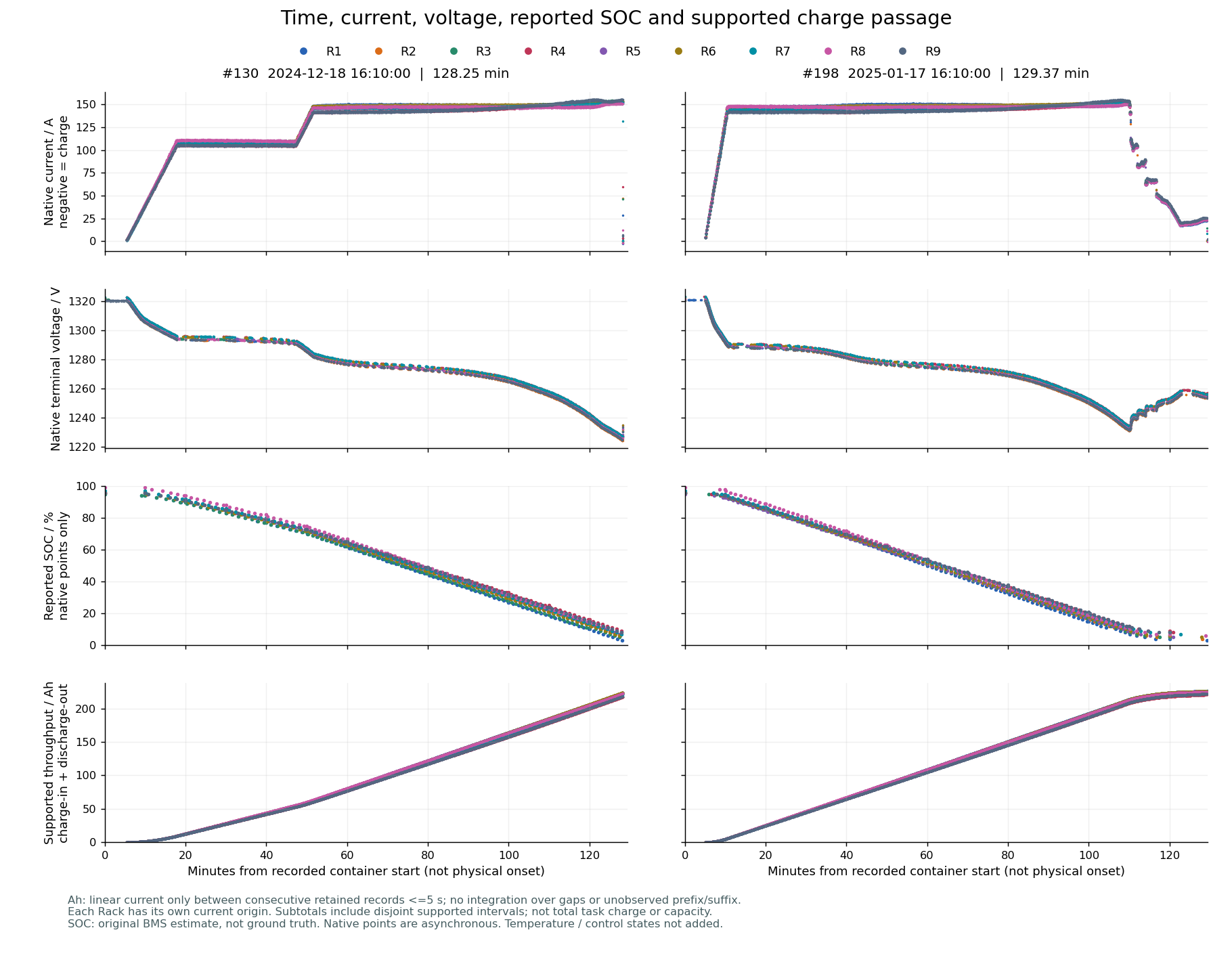
Use shared scales with separate time cursors. Rotate, zoom, highlight a rack and inspect the age of the source records.
Observed The three summaries are close; the retained paths still differ.
Interpretation Actual current also differs. This is not evidence that the battery changed under identical inputs. No difference is labelled as improvement, deterioration or recovery.
MEMBERS BEHIND THE SUMMARY
A separate existing replay retains four custom summaries: median voltage, voltage range, median current and median SOC. Even when all four are exactly equal, the cached voltage records of named members can differ.
The first qualifying instance in each record, not the largest difference.
| Member | Before / V | After / V | Source time before / s | Source time after / s | Recorded value |
|---|
Voltage values are retained as supplied by the source JSON; decimal places do not indicate measurement accuracy. Source times are relative to each stored record's start. Summary cards are rounded for display; equality uses unrounded values. Highlighted rows indicate different cached values, not statistical significance, faults or a burden ranking.
The narrow result: an observer retaining only these four summaries cannot distinguish the two cache states that are already different at the member-record level.
Observed All four selected replay records contain such an instance.
Interpretation Each cache uses the latest available member records, which are not a synchronous physical state. Whether the original BMS uses these distinctions is unknown. This does not justify current limits or intervention.
WHAT THIS CHANGES — AND DOES NOT
Named members, native timestamps and full retained paths let us locate and revisit a difference. They connect a summary back to particular records.
Internal state, material causes, true capacity and control benefits have not been established. The original BMS estimation and decision methods are unknown; a custom summary cannot stand in for its full capability.
The next useful test is specific:
Declare the target, available information and baseline, then test what the added relations contribute.
This exhibit opens an observation question. It does not answer a control decision.
METHOD & SOURCES
This edition reuses existing cases and results. It does not select new data or perform a new analysis. Chronological reading continues; selected examples do not establish representativeness.
English exhibit and full methods account. The original figures and retained values are unchanged; the public replay is limited to the four case records. This is a descriptive methods demonstration, not a peer-reviewed validation.